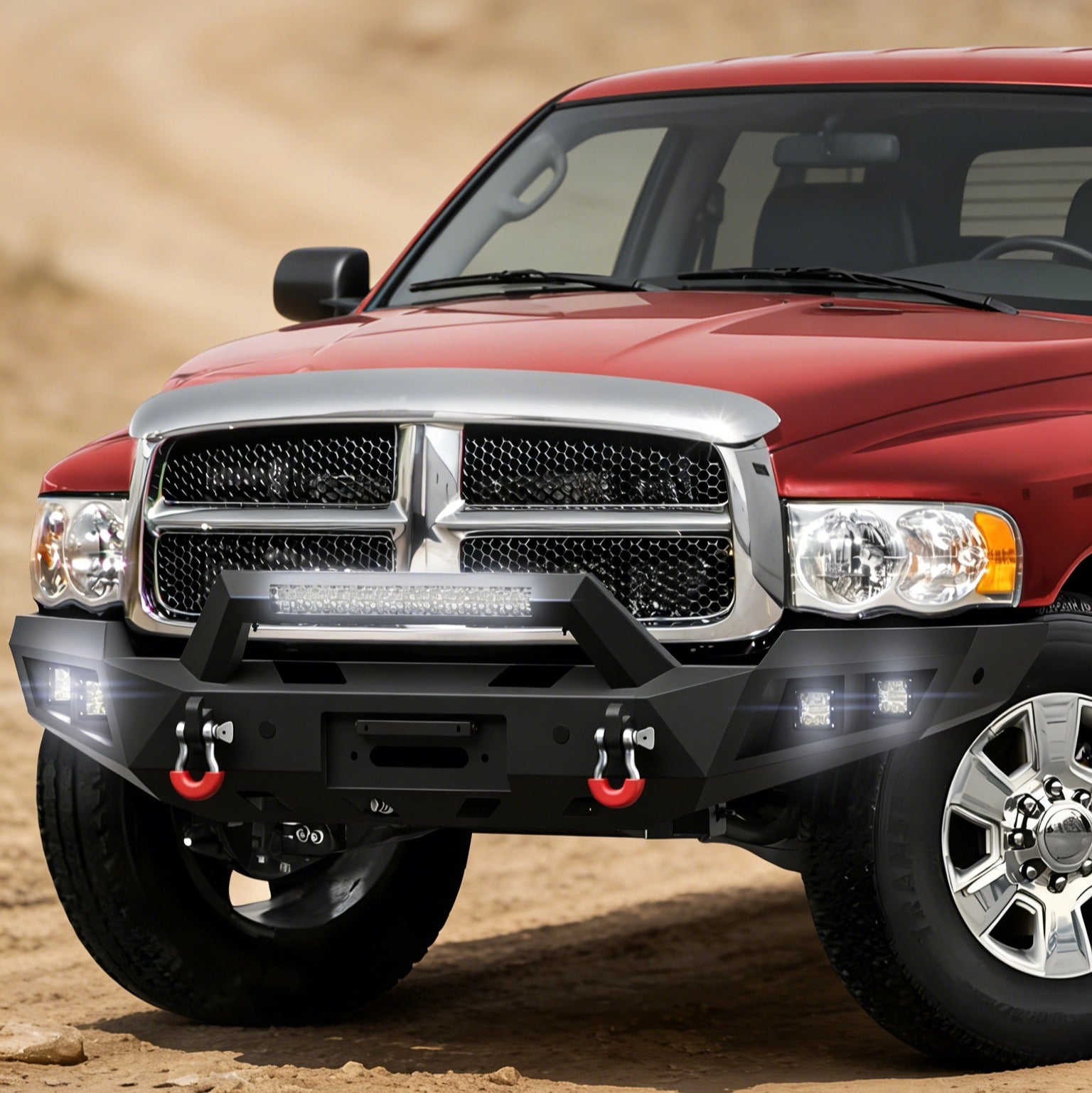
Will a Steel Aftermarket Bumper Be Too Heavy for My Truck? Weight, Payload, Axle Load & Suspension Guide
Prepared by POFENZE Team | Last Updated: September 21, 2026
How This Guide Was Prepared: This guide combines current POFENZE bumper specifications with official vehicle-loading, towing, warranty and vehicle-safety guidance. Product-specific specifications apply only to the exact POFENZE bumper referenced. Vehicle weight ratings, suspension configurations and factory equipment vary by truck.

Disclosure: POFENZE sells aftermarket truck bumpers discussed in this guide. A heavier or stronger-looking bumper should not automatically be interpreted as improving a vehicle's crash performance, towing capacity or payload rating.
A full-width steel aftermarket bumper can weigh well over 100 pounds. Add a winch, fairlead, recovery hardware and auxiliary lights, and it is reasonable to ask:
Will a steel bumper be too heavy for my truck?
The useful answer is not simply yes or no.
The number printed in the bumper specifications is only one part of the calculation. What matters is the finished truck:
Aftermarket bumper + accessories − factory components removed = net added vehicle weight
But even that is not the whole story.
A front bumper sits ahead of the front axle, so the front axle can gain more load than the net weight you added. Likewise, a rear bumper, cargo or trailer tongue load positioned behind the rear axle can add disproportionately to rear-axle loading.
That is why a truck can remain below its overall payload limit while still putting substantial additional load on one axle.
This guide explains how to calculate the weight, estimate axle loading, check your truck's ratings and decide when suspension or other changes deserve closer evaluation.
Quick Answer: Is a Steel Aftermarket Bumper Too Heavy?
Not necessarily.
Before deciding, check five things:
| Question | Why It Matters |
|---|---|
| How much does the bumper weigh? | Establishes the starting accessory weight |
| What factory parts are being removed? | Product weight is not the same as net added weight |
| Are you adding a winch or other accessories? | These increase the completed front-end load |
| Where is the added weight located? | Weight ahead of or behind an axle changes axle loading through leverage |
| What are your truck's GVWR and GAWR? | Total weight and individual axle weight both matter |
The better question is:
How much net weight will my completed bumper setup add to my specific truck, and where will that weight be carried? If you can answer that, you can make a much better decision than relying on a generic rule such as “steel bumpers are too heavy” or “heavy-duty trucks do not care about bumper weight.”
1. How Much Does a Steel Aftermarket Bumper Actually Weigh?
There is no universal aftermarket bumper weight.
Bumper design can change substantially depending on:
- vehicle application;
- full-width or narrower construction;
- steel thickness and reinforcement;
- integrated winch plate;
- grille protection;
- skid plate;
- recovery points;
- integrated steps;
- auxiliary lighting;
- and mounting structure.
Current POFENZE products illustrate that variation.
| POFENZE Application | Configuration | Published Product Weight |
|---|---|---|
| 2005–2015 Toyota Tacoma | Front bumper | 123 lb |
| 2010–2018 Ram 2500/3500 R1001POF | Front bumper | 127 lb |
| 2019–2026 Ram 2500/3500 BPR1004POF | Front bumper | 132 lb |
| 2010–2018 Ram 2500/3500 BT2022023POF | Front bumper | Approx. 137 lb |
| 2010–2018 Ram 2500/3500 R1002POF | Rear bumper | Approx. 83 lb |
| 2019–2026 Ram 2500/3500 R1004R1005POF | Front + Rear | 211 lb total |
For example, the current POFENZE 2005–2015 Tacoma front bumper is listed at 123 lb, while BPR1004POF for the 2019–2026 Ram 2500/3500 is listed at 132 lb.
These numbers are useful—but they are product weights, not the final amount of weight added to the truck.
That distinction matters.
Compare POFENZE Bumpers for Your Truck
Browse POFENZE front bumpers, rear bumpers and bumper sets by vehicle. Compare product weight, fitment, winch capability and included equipment before choosing your setup.
2. Product Weight Is Not Net Added Vehicle Weight
Installing a replacement bumper normally means removing factory components first.
Therefore:
A 132-lb aftermarket bumper does not automatically make the truck 132 lb heavier.
A practical starting formula is:
Net Added Weight
Net Added Weight ≈ New Bumper + Added Accessories − Factory Components Removed
For a winch-equipped front bumper:
Net Added Weight ≈ Aftermarket Bumper + Winch + Fairlead + Added Hardware − Removed Factory Components
This difference matters because two owners buying exactly the same bumper can create very different finished trucks.
One may install:
- bumper only
while another installs:
- bumper + winch + fairlead + lights + recovery equipment
Do not assume the factory bumper weighs a certain amount based on a forum post or another model year. Factory bumper assemblies, brackets, reinforcement bars, trim and equipment vary.
If the exact number matters, weigh the parts you remove.
Worked Example: A Steel Bumper + Winch Build
The following example is intended to demonstrate the calculation method.
Only the 123-lb POFENZE bumper weight is an actual published product specification. All other weights and dimensions below are hypothetical examples and should be replaced with measurements from the actual truck and accessories.
Assume a truck is receiving the POFENZE 2005–2015 Tacoma front bumper.
| Component | Example Weight | Source |
|---|---|---|
| POFENZE front bumper | 123 lb | Published specification |
| Winch | 50 lb | Illustrative assumption |
| Fairlead + mounting hardware | 10 lb | Illustrative assumption |
| Total components added | 183 lb | Calculated |
| Factory bumper/components removed | −40 lb | Illustrative assumption |
| Net added vehicle weight | +143 lb | Calculated |
The finished truck in this example becomes approximately 143 lb heavier.
Not 123 lb.
Not 183 lb.
About 143 lb.
If the vehicle-specific payload capacity were hypothetically 1,200 lb, that 143-lb permanent addition would consume approximately:
143 ÷ 1,200 ≈ 11.9%
of that capacity before accounting for passengers, cargo or other accessories.
But we still have not answered the most important front-bumper question:
How much of that 143 lb reaches the front axle?
The answer can actually be more than 143 lb.
3. Why Front-Mounted Weight Can Load the Front Axle More Than Its Own Weight
A bumper and winch are mounted ahead of the front axle.
Think of the truck as a lever supported at two points:
Front axle ↔ wheelbase ↔ rear axle
When weight is placed in front of the front axle, that weight creates a moment around the vehicle.
The result is:
- additional load on the front axle;
- some unloading of the rear axle.
For a simple static estimate:
Front Axle Load Increase
Δ Front Axle Load ≈ W × (L + a) ÷ L
Rear Axle Load Change
Δ Rear Axle Load ≈ −W × a ÷ L
Where:
- W = net added weight;
- L = wheelbase;
- a = distance from the front axle to the effective center of the added weight.
Continuing the Worked Example
Assume:
- Net added weight = 143 lb
- Wheelbase = 10.5 ft
- Effective center of added weight = 2.7 ft ahead of the front axle
Again, these geometry values are examples only and do not represent every Tacoma configuration.
Estimated Front Axle Increase
143 × (10.5 + 2.7) ÷ 10.5 ≈ 180 lb
Estimated Rear Axle Change
−143 × 2.7 ÷ 10.5 ≈ −37 lb
Check:
+180 − 37 = +143 lb
The vehicle still gained only 143 lb overall.
But the front axle gained approximately 180 lb.
That is about 26% more front-axle load than the net vehicle weight increase in this specific example.
This helps explain why a truck can remain comfortably inside its overall payload rating while still showing:
- a lower front stance;
- reduced front suspension travel;
- changed steering feel;
- or a smaller margin to Front GAWR.
Ford's current towing guidance similarly treats Front GAWR and Rear GAWR as separate limits and states that each axle has its own maximum rated load.

Important Limitation
This is a simplified static model.
It does not account for:
- suspension geometry;
- exact component locations;
- braking load transfer;
- acceleration;
- road impacts;
- spring rates;
- anti-roll bar behavior;
- or dynamic off-road loading.
It is best used as a planning estimate, not as a substitute for actual axle-scale measurements.
For greater accuracy, calculate the moment of each added and removed component separately rather than treating all net weight as one lump.
And when the available axle margin is small, measure the truck.
4. Payload, GVWR and GAWR: Know the Difference
Bumper buyers often look at payload first.
Payload matters—but it is not the only rating that matters.
Payload
Payload describes how much additional weight the vehicle can carry within its rated configuration.
Permanent aftermarket equipment uses some of that available capacity.
That can include:
- bumper;
- winch;
- skid plates;
- tools;
- bed rack;
- roof rack;
- recovery equipment;
- passengers;
- cargo;
- and trailer tongue weight.
GVWR
GVWR — Gross Vehicle Weight Rating — is the maximum rated total weight of the vehicle itself when loaded.
Do not assume that installing heavier-duty springs increases the manufacturer's GVWR.
It may change ride height or suspension response, but it does not automatically rewrite the vehicle's certified weight rating.
GAWR
GAWR — Gross Axle Weight Rating — is the maximum rated load for an individual axle.
That means your truck has a:
- Front GAWR
- Rear GAWR
Ford's current guidance specifically defines GAWR as the maximum weight each axle is designed to support and directs owners to the driver-side door-jamb label or owner's manual for the applicable figures.
This distinction is especially important for steel front bumpers because the front axle may gain more load than the vehicle's overall net weight increase.
Where Should I Find My Truck's Weight Information?
Start with your actual vehicle.
NHTSA identifies the Tire and Loading Information Label around the driver's-side door edge or door-jamb area as an important source of vehicle-specific loading information.
Also check:
- the vehicle certification label;
- owner's manual;
- manufacturer towing/loading documentation;
- and vehicle-specific VIN-based information where available.
Do not use the manufacturer's highest advertised payload for the entire model line as though it applies to every truck.
For example, Ram currently advertises a maximum gas payload of 3,930 lb for the 2026 Ram 2500. That is a maximum configuration figure—not proof that every 2026 Ram 2500 has 3,930 lb of payload capacity.
Engine, cab, drivetrain, bed, trim and factory options can change the actual rating.
Use the information for your truck.
Weight Is Only One Part of Bumper Fitment
Before choosing a replacement bumper, also confirm your truck's exact year, model, trim, factory sensors and other bumper-area equipment.
Read the POFENZE Bumper Fitment Checklist →
5. How Can Steel Bumper Weight Change the Way a Truck Drives?
The bumper is part of the truck's sprung mass because its weight is supported through the suspension.
Adding substantial sprung mass toward the front of the vehicle can change the suspension's static operating position.
Possible effects can include:
- lower static front ride height;
- reduced available suspension travel;
- changed steering feel;
- more noticeable brake dive;
- altered alignment;
- increased or uneven tire wear if alignment changes;
- and reduced clearance if the front of the truck settles.
Bumper geometry itself can also change approach angle independently of weight.
Do not confuse the two effects:
- Bumper design → may change approach angle
- Added weight → may change ride height and usable suspension travel
Likewise, adding bumper weight alone should not automatically be blamed for every change in handling.
Large tires, wheel offset, suspension lifts, worn shocks, worn springs and alignment condition can all affect how the truck feels after modifications.
6. Will a Steel Bumper Make My Truck Sag?
It can.
But there is no honest universal number such as:
“Every truck needs new springs if it drops one inch.”
Different trucks use different:
- spring rates;
- suspension travel;
- axle ratings;
- control-arm geometry;
- factory rake;
- engines;
- and suspension packages.
A better approach is to establish your own baseline.
Before Installation
Park the truck on level ground and record ride height from the same repeatable reference points.
Also record:
- tire pressure;
- current front/rear axle weight if available;
- existing suspension modifications;
- and whether the vehicle already sits unevenly.
After Installation
Measure again after installing the complete planned configuration, preferably including the winch if one will be used.
Then check for:
- persistent ride-height reduction;
- left-to-right height difference;
- reduced suspension clearance;
- contact with bump stops;
- steering changes;
- pulling;
- alignment outside specification;
- tire-clearance issues;
- or abnormal tire wear.
Rather than using an arbitrary universal inch/mm threshold, use the actual vehicle specification and symptoms.
7. Do I Need a Suspension Upgrade After Installing a Steel Bumper?
Not automatically.
A bumper-only installation on one truck can behave very differently from a bumper + winch + skid-plate installation on another.
There are two types of decision points worth separating.
Hard Limits
These should not be treated as optional:
Do not intentionally exceed the vehicle's GVWR or the applicable Front/Rear GAWR.
If your calculated or measured loaded axle weight reaches the manufacturer's rating, adding stiffer springs is not a substitute for reducing load.
Evaluation Triggers
Have the suspension/alignment evaluated when the completed setup produces problems such as:
- clearly measurable permanent front-end sag;
- insufficient suspension travel;
- steering behavior that changed after the modification;
- alignment outside specification;
- new uneven tire wear;
- tire or component interference;
- or an unusually small margin between actual axle weight and GAWR.
This gives you a more useful decision rule than saying every steel bumper requires a suspension upgrade.
8. Plan the Bumper and Winch as One System
A common planning mistake is:
- Choose bumper.
- Install bumper.
- Decide on a winch months later.
- Discover that weight, dimensions or clearance create a new problem.
If a winch is part of the eventual build, plan for it from the beginning.
Consider:
Bumper + Winch + Fairlead + Hardware + Wiring
as one finished system.
POFENZE's winch-fitment guidance also emphasizes that winch rating and physical winch fitment are separate questions. Two winches advertised at the same capacity can have different mounting footprints, body dimensions, control-box locations and clutch-handle positions.
A POFENZE bumper with a winch plate specified for up to 12,000 lb does not mean every 12,000-lb winch has the same dimensions or fits automatically.
Before purchasing, check:
Truck → Bumper → Winch Plate → Exact Winch → Dimensions → Mounting Pattern → Clearance → Weight
Planning to Add a Winch?
Winch capacity alone does not confirm fitment. Check the exact winch dimensions, mounting pattern, control-box clearance, clutch access and completed front-end weight before purchasing.
Read the POFENZE Winch Fitment Guide →
9. Rear Bumpers Have Their Own Lever Effect—Especially When Towing
The same physics works at the rear of the truck.
A weight positioned behind the rear axle:
- increases rear axle load;
- and unloads some weight from the front axle.
For a simplified static model:
Rear Axle Increase
Δ Rear Axle Load ≈ W × (L + b) ÷ L
Front Axle Change
Δ Front Axle Load ≈ −W × b ÷ L
Where:
- W = weight added behind the rear axle;
- L = wheelbase;
- b = distance behind the rear axle.
This matters when a truck combines:
steel rear bumper + towing equipment + bed cargo + trailer tongue weight
because all of those can contribute to rear-axle loading.
Trailer Tongue Weight Counts Too
Tongue weight is the downward force the trailer places on the hitch.
Ford states that conventional trailer tongue weight is generally around 10–15% of loaded trailer weight, while also emphasizing that the vehicle and hitch's maximum tongue-weight specifications must not be exceeded.
Chevrolet's current trailering guidance explicitly includes trailer tongue weight when calculating loaded vehicle weight against GVWR and separately requires the truck/trailer combination to remain within GCWR.
Therefore:
An aftermarket rear bumper does not increase your truck's towing capacity.
When towing, check the complete system:
rear bumper + hitch + passengers + cargo + tongue weight + Rear GAWR + GVWR + GCWR + hitch rating
A heavy-duty-looking bumper should never be used as evidence that the vehicle can tow more than the manufacturer specifies.

10. Steel vs. Aluminum: Is a Lighter Bumper Automatically Better?
No.
Weight is an important design variable, but it should not be treated as a complete quality rating.
In general:
| Factor | Steel Bumper | Aluminum Bumper |
|---|---|---|
| Weight | Usually heavier | Usually lighter |
| Material density | Higher | Lower |
| Rust | Requires corrosion protection | Does not rust like carbon steel, although corrosion can still occur |
| Repair/fabrication | Common fabrication processes | Requires appropriate aluminum repair/welding processes |
| Cost | Often lower depending on design | Often higher depending on construction |
| Strength | Depends on grade, thickness and structure | Depends on alloy, thickness and structure |
The important point is:
Material name alone does not tell you how strong, durable or appropriate a bumper is.
A bumper's performance also depends on:
- material grade;
- thickness;
- bending geometry;
- reinforcement;
- weld design;
- mounting structure;
- and intended application.
POFENZE currently uses carbon-steel construction on many of its truck bumper applications, often combined with E-coating and textured powder coating for corrosion protection.
If minimizing weight is your top priority, material deserves more attention.
If winch integration, steel construction or a particular vehicle-specific bumper configuration is the priority, additional weight may be an acceptable tradeoff.
11. Does a Steel Aftermarket Bumper Affect Crash Safety or Airbags?
This question deserves a careful answer.
A steel bumper should not be advertised or assumed to improve vehicle crash safety simply because it is heavier or appears stronger.
Modern vehicle crash protection is a system involving:
- vehicle structure;
- load paths;
- restraint systems;
- sensors;
- crush behavior;
- and electronic controls.
NHTSA has explained that whether front-end accessory structures affect an airbag system depends on the design of the accessory, the vehicle and the airbag system. NHTSA specifically noted that changing the load path into the vehicle structure could alter the crash impulse reaching the sensing system.
That does not mean every aftermarket bumper causes an airbag problem.
It means:
“Stronger steel” and “better crash protection” are not interchangeable claims.
POFENZE therefore does not recommend assuming that a replacement steel bumper improves occupant crash protection simply because of material strength.
Do not remove, relocate, drill around or modify safety-related components unless the applicable installation requirements support that work.
12. Parking Sensors, Radar, Cameras and Other Electronics Are a Separate Fitment Check
Another mistake is treating every circular or electronic device near the bumper as an “airbag sensor.”
Modern trucks may use separate systems for:
- ultrasonic parking assistance;
- adaptive cruise control;
- forward collision warning;
- automatic emergency braking;
- blind-spot monitoring;
- cameras;
- and other driver-assistance functions.
NHTSA has specifically addressed sensors mounted in bumper areas for crash-mitigation systems and treated those sensors as distinct components rather than simply part of the bumper structure.
That is why POFENZE recommends separating:
from:
Electronic Compatibility
A bumper may bolt correctly to the truck and still require additional work for sensors, radar or other electronic equipment.
Before ordering, inspect the factory bumper and identify what is actually installed.
Not Sure About Your Truck's Sensors or Fitment?
Send POFENZE your year, make, model, trim, the bumper SKU you're considering, and clear photos of the factory bumper. If your truck has parking sensors, cameras, radar or other bumper-area electronics, include clear photos of those components as well.
Contact POFENZE for Fitment Help →
13. Will an Aftermarket Bumper Void My Truck Warranty?
Installing an aftermarket bumper does not automatically cancel the entire vehicle warranty.
The U.S. Federal Trade Commission states that a vehicle warranty remains in effect when aftermarket or recycled parts are used.
However, if an aftermarket part is defective or installed incorrectly and causes damage to another component, warranty coverage for that related damage may be denied. The FTC states that the manufacturer or dealer must establish that the aftermarket or recycled part caused the damage before denying warranty coverage on that basis.
FTC guidance also explains that companies generally cannot condition warranty coverage on consumers using specified branded parts or services unless applicable exceptions apply.
That does not mean every modification-related problem is automatically covered.
A good practice is to keep:
- bumper receipt;
- exact SKU;
- installation instructions;
- installation records;
- photos;
- and records of any professional work or recalibration.
If a modification changes factory safety, structural or electronic equipment, confirm the requirements for the specific vehicle.
14. What About Insurance?
Insurance treatment can vary by:
- insurer;
- policy;
- modification;
- state;
- and whether you want the aftermarket equipment itself covered.
Do not assume a bumper modification is automatically covered—or automatically excluded.
If the bumper, winch or other accessories represent significant value, ask your insurer whether modifications need to be disclosed and what documentation is required for accessory coverage.
15. How Much Bumper Weight Is “Too Much”?
There is no credible single number such as:
100 lb = safe
or:
200 lb = too heavy
for every truck.
Instead, use four decision tests.
Test 1 — Vehicle Weight
Will the completed truck remain below GVWR?
Test 2 — Axle Weight
Will the front and rear axle remain below their respective GAWRs?
For a front bumper/winch build, do not assume the front axle gains only the truck's net added weight.
Test 3 — Suspension Behavior
After installation, does the truck maintain acceptable:
- ride height;
- suspension travel;
- alignment;
- steering;
- tire clearance;
- and tire wear?
Test 4 — Intended Use
A truck used for:
- towing;
- carrying tools;
- carrying a slide-in load;
- overlanding;
- snowplow work;
- or other permanent accessories
may already use significantly more of its available capacity than an otherwise stock daily driver.
The correct answer depends on the finished vehicle—not bumper weight in isolation.
16. A Better 8-Step Pre-Purchase Weight Check
Before ordering a steel aftermarket bumper, use this process.
-
Step 1 — Identify the Exact Bumper
Confirm:
year → make → model → generation → trim → factory equipment → exact bumper SKU -
Step 2 — Record Published Bumper Weight
Use the specification for the exact product you are buying.
Do not use the weight from a visually similar bumper. -
Step 3 — Decide What Will Be Installed With It
Include:
winch;
fairlead;
lighting;
recovery equipment;
brackets;
and other permanent accessories. -
Step 4 — Account for Factory Components Being Removed
If an accurate number matters, weigh them. -
Step 5 — Calculate Net Added Weight
Use:
Added components − removed components -
Step 6 — Estimate Axle Load
For a front bumper, account for the fact that the assembly is ahead of the front axle.
For a rear bumper/towing setup, account for loads behind the rear axle. -
Step 7 — Compare With Vehicle-Specific Ratings
Check:
GVWR;
Front GAWR;
Rear GAWR;
payload;
and GCWR/tongue-weight limits when towing. -
Step 8 — Verify the Finished Truck
When the margin is small or the truck is heavily modified, actual measurement is better than estimation.
Ford recommends using onboard scales where equipped or a weight station/public scale to measure relevant towing loads.
For a modified truck, obtaining:
total vehicle weight + front axle weight + rear axle weight
provides far more useful information than relying only on catalog accessory weights.
17. What POFENZE Product Weight Data Can—and Cannot—Tell You
POFENZE publishes product weight for many bumper applications to help buyers compare configurations.
For example:
BPR1004POF — 2019–2026 Ram 2500/3500
Front bumper
132 lb
Winch plate specified up to 12,000 lb
144W + 4×18W LED lighting
2×4.75T D-rings
Current POFENZE Ram 2500 Bumper Buying Guide also lists several 2010–2018 front, rear and complete bumper configurations ranging from approximately 83 lb for one rear bumper to 220 lb for one complete front/rear configuration.
These specifications help you begin the calculation.
They do not tell you:
- your exact net vehicle weight change;
- actual front/rear axle weight;
- remaining payload;
- whether your suspension needs modification;
- or whether a specific winch physically fits.
Those answers depend on the truck and completed build.
Frequently Asked Questions
How much does a steel aftermarket bumper really add to my truck?
Usually not exactly the bumper's listed product weight.
A practical estimate is:
Net Added Weight = New Bumper + Accessories − Factory Components Removed
If a 123-lb bumper is installed with a 50-lb winch and 10 lb of related equipment while 40 lb of factory components are removed, the illustrative net increase would be approximately 143 lb.
Use measured values from your actual truck whenever accuracy matters.
Why can the front axle gain more weight than the bumper actually adds?
Because the bumper and winch sit ahead of the front axle.
The added weight creates leverage around the vehicle's wheelbase, increasing front-axle load while slightly unloading the rear axle.
The exact multiplier is not universal. It depends on:
distance ahead of front axle ÷ wheelbase
In the worked example in this guide, 143 lb of net added weight produced an estimated 180-lb front-axle increase because of the assumed geometry.
Will a steel bumper make the front of my truck sag?
It can.
The result depends on bumper weight, winch/accessories, spring condition, vehicle configuration and existing modifications.
Measure ride height before and after installing the complete planned setup. If you find a persistent height change together with alignment, steering, clearance or tire-wear concerns, have the suspension and alignment evaluated.
There is no POFENZE universal sag threshold that applies to every truck.
Do I need a suspension upgrade after installing a steel bumper?
Not automatically.
Consider a suspension evaluation if the finished truck develops measurable sag, insufficient suspension travel, alignment changes, steering issues or abnormal tire wear—or if measured front axle weight leaves very little margin to Front GAWR.
A stiffer spring does not increase the manufacturer's GAWR.
Should I choose my winch before the bumper?
Ideally, plan them together.
The winch, fairlead and hardware add weight in the same front-end area, and physical winch dimensions also affect compatibility.
A bumper being rated for a certain winch capacity does not guarantee that every winch with that rating has the correct mounting pattern or dimensions.
Does adding a steel rear bumper reduce towing capacity?
The bumper itself does not rewrite the manufacturer's tow rating.
However, its weight becomes part of the loaded truck and reduces the capacity available for other equipment, cargo and trailer tongue load.
When towing, check:
Rear GAWR + GVWR + GCWR + payload + hitch rating + tongue weight
rather than looking only at advertised towing capacity.
Does trailer tongue weight count against payload?
Yes, it contributes to the loaded vehicle.
Chevrolet's current trailering guidance explicitly includes trailer tongue weight when comparing vehicle weight with GVWR.
Because tongue weight is applied behind the rear axle, it can also increase rear-axle load while reducing some front-axle load.
Will a leveling kit or heavier spring increase my truck's GAWR?
Do not assume so.
Suspension modifications can change ride height and how the truck responds to load, but you should continue to use the vehicle manufacturer's applicable GVWR and GAWR unless the appropriate legal/certification documentation specifically establishes otherwise.
Is an aluminum bumper better if I am worried about weight?
It may reduce accessory weight, but material alone should not determine the purchase.
Compare:
- total product weight;
- vehicle-specific fitment;
- construction;
- thickness;
- reinforcement;
- mounting design;
- corrosion protection;
- winch requirements;
- and intended use.
A lighter bumper is not automatically better, and a heavier bumper is not automatically stronger.
Does a steel bumper make my truck safer in a crash?
POFENZE does not recommend making that assumption.
Vehicle crash performance depends on the complete vehicle structure, restraint system, sensors and crash-management design.
NHTSA has noted that changing the way front-end structures transmit crash loads can potentially alter the crash impulse reaching airbag sensing systems.
Choose an aftermarket bumper for its documented vehicle fitment and product features—not based on an unsupported assumption that heavier steel automatically improves crash safety.
Will an aftermarket bumper void my truck warranty?
Not automatically.
FTC consumer guidance states that using aftermarket parts does not by itself eliminate the vehicle warranty. However, damage actually caused by a defective aftermarket component or incorrect installation may not be covered.
Keep your product and installation records.
Final Takeaway: Calculate the Finished Truck, Not Just the Bumper
The most useful question is not:
“Is a 130-lb steel bumper too heavy?”
It is:
“What will my completed bumper system do to the total weight and axle loads of my specific truck?”
Use this sequence:
Exact Truck → Exact Bumper → Accessories → Removed Factory Parts → Net Added Weight → Weight Position → Front/Rear Axle Load → GVWR/GAWR → Suspension Behavior
For towing:
add tongue weight + GVWR + Rear GAWR + GCWR + hitch limits
And remember one particularly important point:
A front bumper and winch located ahead of the front axle can increase front-axle load by more than their net addition to total vehicle weight.
That is why evaluating only payload can miss part of the picture.
Likewise, do not assume that heavier steel automatically means better crash protection, that a suspension upgrade increases axle ratings, or that an aftermarket rear bumper increases towing capacity.
The best bumper setup is one that:
- fits the exact truck;
- retains the factory functions you need;
- provides the recovery or protection features you actually use;
- stays within vehicle and axle ratings;
- and works with the completed suspension, winch and towing configuration.
Find the Right POFENZE Bumper for Your Truck
Ready to compare options? Browse POFENZE vehicle-specific front bumpers, rear bumpers and bumper sets for popular Toyota, Ram, Ford, Chevrolet, GMC, Jeep and Nissan truck applications.

Before choosing your setup, compare:
- vehicle fitment;
- published product weight;
- winch compatibility;
- parking-sensor provisions;
- included lighting and recovery equipment;
- and installation requirements.
Not sure which bumper fits your truck? Send POFENZE your year + make + model + trim + bumper SKU + clear photos of the factory bumper.